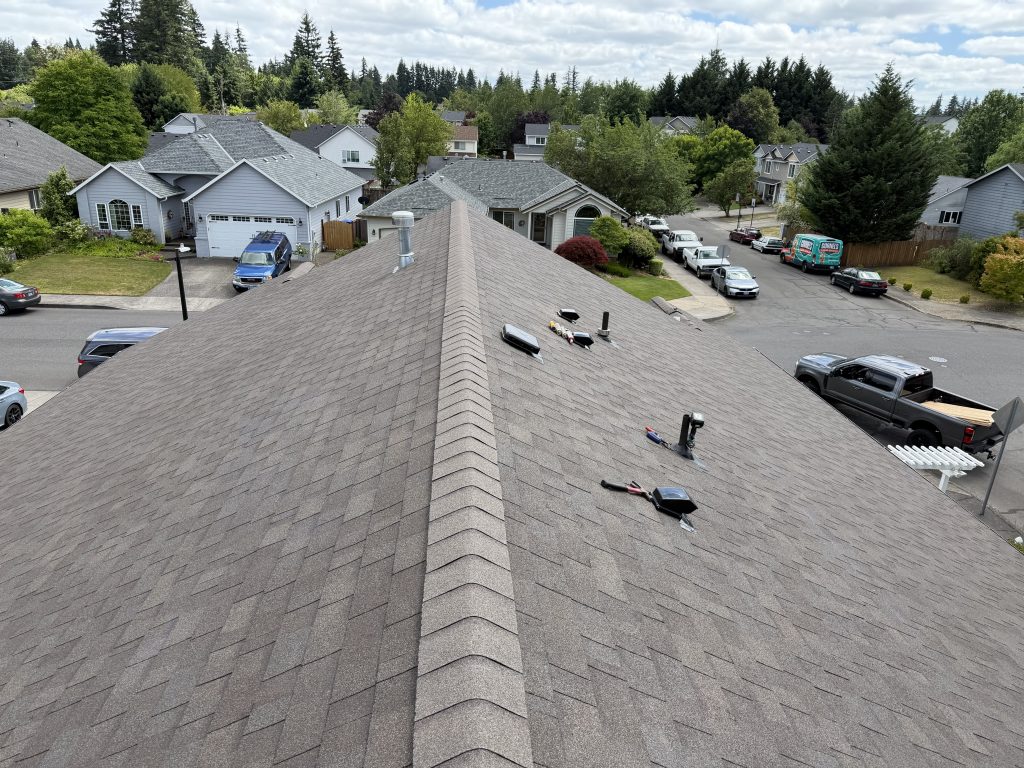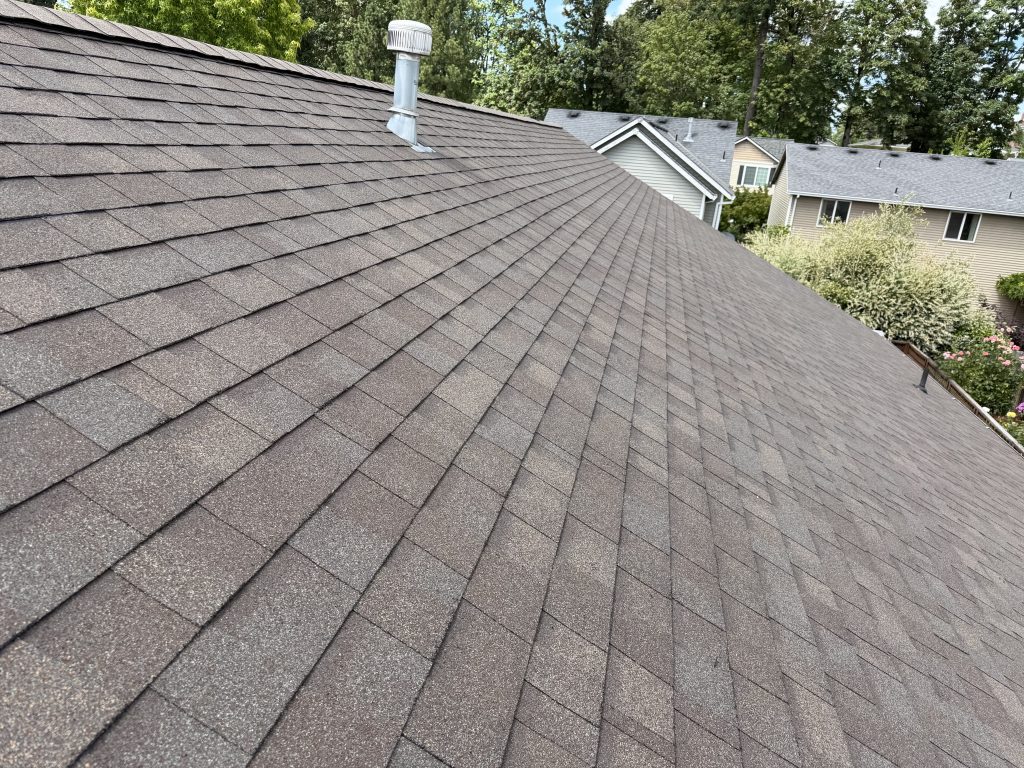
Every shingle brochure gives a lifespan. Very few roofs in Boring, Sandy or Gresham reach it. That is not because the products are bad. It is because the brochure number assumes an average climate, and the east side of the Portland metro is anything but average: about 60 inches of rain a year in Sandy, a wet season that runs from mid October into May, tree cover that keeps north slopes damp, and the Gorge east wind working on every edge and ridge. This post explains what actually sets a roof’s lifespan here and how to tell where yours is.
What shortens a roof east of Portland
Moisture that never leaves
Asphalt shingles are designed to get wet and dry out. A shaded slope that stays damp for seven months grows moss, and moss holds water against the shingle and the deck. Read our guide to roof moss for the full picture, or OSU Extension’s own guidance. The short version: moss is the most common reason a roof here fails early.
Wind
Gresham, Troutdale and Corbett get repeated high-wind events every winter. Each one tests the sealant strip on every shingle. As shingles age that strip weakens, and the roof starts to lose tabs at the edges. See what to check after a Gorge wind event.
Attic ventilation
A poorly vented attic traps warm, moist air under the deck. That cooks shingles from below in summer and lets condensation form in winter. Many homes built before the 1990s in this area have far less intake and exhaust ventilation than a modern roof calls for.
Installation quality
Nails placed too high, missing starter strip, and skipped ice barrier in valleys all take years off a roof. You cannot see these from the ground, which is why an inspection with photos is worth more than a guess based on age.
Seven signs a roof is near the end
- Curling or cupping shingle edges, visible from the street
- Bare patches where granules have worn off, or heavy granule buildup in the gutters
- Cracked or missing shingles on more than one slope
- Moss that has been there long enough to leave the deck soft when walked on
- Daylight visible through the roof boards from inside the attic
- Sagging along the ridge or between rafters
- Repeated leaks in different places rather than one recurring spot
One of these is a reason to get an inspection. Three or more usually means the question is when to replace rather than whether.
Getting a straight answer
We offer annual, real estate, storm damage and pre-purchase inspections, and every one includes a digital photo report. You see the same pictures we see. If the roof has years left, we tell you that and suggest a maintenance plan. If it does not, you get a real replacement estimate with the three Malarkey tiers priced out.
Buying a home in Boring, Sandy or Happy Valley?
A general home inspector looks at the roof from a ladder or the ground for a few minutes. A pre-purchase roof inspection gets on the roof and into the attic. On a home with mature trees or a north-facing main slope, that is money well spent before the offer goes in.
Reading the brochure number correctly
When a shingle package says a product is warranted for a certain number of years, that is a warranty term. A prediction about your particular roof is a different thing. Manufacturer warranties cover defects in the shingle itself. They do not promise that a shingle on a shaded north slope in Sandy, under a fir, with a poorly vented attic, will look good for that many years. The warranty is about the product. The lifespan is about the product plus the roof it is on plus the weather it lives in.
That distinction explains most of the disappointment homeowners feel when a roof gives out early. Nothing was defective. The environment did what the environment does here, and nobody was cleaning the moss off.
The slope that ages the house
A roof does not age evenly. The south-facing slope gets the most sun and the most UV exposure, which dries the asphalt and eventually makes it brittle. The north-facing slope gets the least sun and stays wet, which grows moss. On many homes east of Portland, the north slope is the one that decides when the roof gets replaced, because moss damage reaches the deck long before the south slope has worn out.
This is worth knowing if you are deciding between a repair and a replacement. A roof with one bad slope and three good ones can sometimes be handled as a partial replacement. It depends on where the transitions fall and whether the rest of the roof has years left, and that is a conversation to have with photos in hand.
Attic ventilation, explained without the jargon
An attic needs air coming in low (at the eaves or soffits) and going out high (at the ridge or through roof vents). When that flow works, the attic stays close to outdoor temperature and moisture from the house escapes. When it does not work, two things happen. In summer the attic overheats and cooks the shingles from underneath. In winter warm, damp air from the house rises into the attic, hits the cold underside of the roof deck, and condenses. That condensation is a leak that comes from inside, and it rots decking just as effectively as rain.
Older homes in Gresham, Boring and Estacada often have soffit vents that were painted shut decades ago, or insulation pushed into the eaves that blocks the intake. A roof replacement is the natural time to fix that, because the crew is already at the ridge and the eaves. It is a small line item that changes how long the new roof lasts.
How installation decisions show up ten years later
Some of the most common roof failures we see were decided on installation day. High nailing, where the fastener misses the reinforced nail zone, holds fine until the first strong wind and then does not. Missing starter strip at the eave and rake leaves the first course with nothing to seal to. Skipped ice and water barrier in the valleys means the one place where water concentrates has the least protection. Reused step flashing at a wall, bent and re-bent, opens a gap the rain finds within a couple of winters.
None of these are visible from the driveway when the roof is new, and all of them shorten the roof’s life. This is why manufacturer certification matters. The Malarkey Certified Pro program is, in practical terms, a commitment to installing the way the manufacturer specifies, and it is why we hold that certification (#5838, verifiable on Malarkey’s site).
What an inspection actually checks
A roof inspection with a photo report is the difference between guessing and knowing. On the roof, we look at shingle condition slope by slope, check for lifted tabs and sealant failure, examine every penetration (pipe boots, vents, skylights, chimney), check flashing at walls and valleys, and note moss and debris. In the attic, we look for daylight, water staining on the underside of the deck, condensation marks, and whether the ventilation is working. From the ground, we check gutters for granule buildup and look at the eaves and fascia for water damage.
Every photo goes in the report. If we say the roof has a few years left, the photos back that up. If we say it does not, you can see why. We offer annual, real estate, storm damage and pre-purchase inspections, and the report format is the same for all four.
Timing a replacement on your own terms
The worst way to replace a roof is after it leaks in January. You are choosing a contractor under pressure, working around weather, and often paying for interior repairs on top of the roof. The best way is to know, from an inspection, that the roof has roughly two seasons left, and to schedule the replacement for a dry stretch the following summer. That gives you time to compare bids, pick a tier, arrange financing through Hearth if you want it, and get on the calendar before it fills.
A maintenance plan makes that kind of foresight routine. The annual inspection tells you where the roof stands, and you get a year’s warning instead of a wet ceiling. Details are on our services page.
Extending the roof you have
- Keep moss off the north slope with a scheduled treatment rather than a one-time cleaning.
- Trim trees back so the roof gets sun and sheds needles.
- Clean gutters in late fall so water does not back up under the first course.
- Fix small things early: one cracked pipe boot is cheap; the rotted decking under it is expensive.
- Get the attic ventilation checked, especially on homes built before the 1990s.
Done consistently, that list is the difference between a roof that reaches its potential and one that quits early. When it is time, the instant estimate gives you a real number for your address in under a minute.
Skylights, chimneys and the parts that fail first
A roof is only as old as its weakest detail, and the details usually give out before the field shingles. Skylight flashing kits and seals have their own lifespan. Chimney counterflashing rusts, and the mortar joint it was set into crumbles. Pipe boots crack. Valleys take the most water and lose granules first. When we say a roof “has a few years left,” we mean the field shingles do; we will also tell you which details need attention now so the roof actually reaches those years. If you are replacing the roof, replacing a tired skylight with a new Velux unit at the same time is far cheaper than doing it later, because the flashing is being done anyway.
Two roofs, same age, different outcomes
Picture two identical houses built the same year on the same street in Sandy. One sits in an open lot with a south-facing main slope. The other backs onto a stand of firs with its main slope facing north. Fifteen years on, the first roof is weathered but sound. The second has moss along the whole north side, soft decking near the eave, and a leak over the back bedroom. Same shingles, same installer, same brochure number. The environment made the decision. This is the single most useful thing to understand about roof lifespan east of Portland: the site matters as much as the product, and the site is the one thing a maintenance plan can partly offset.
What to keep for the next owner
If you know when the roof was installed, who installed it, what product went on, and whether the warranty was registered, write it down and keep it with the house papers. Buyers ask, inspectors ask, and insurers increasingly ask. Every roof we install comes with a manufacturer warranty registration filed in your name and a photo record of the job, so that file starts full.
One last point about age. A roof installed in 2010 on a home in Gresham has lived through more than a dozen east-wind seasons and roughly a decade and a half of seven-month wet seasons. Age alone tells you what it has been through. The inspection tells you how it coped.
Frequently asked questions
Can a roof be repaired instead of replaced?
Often, yes. Localized damage on a roof with sound shingles elsewhere is a repair. Widespread wear is a replacement, because new shingles will not bond well to old, brittle ones around them.
Does a new roof come with a warranty?
Yes. Every replacement includes a manufacturer warranty from Malarkey, which we register on your behalf, and our workmanship warranty covering the installation.
How much does it cost to replace?
It depends on size, pitch, tear-off and the shingle tier. Read what drives roof cost in Oregon, or get an instant estimate for your address.
How long does the replacement take?
Most single family homes are done in one to two days.
Want to know where your roof stands? Get a 60-second instant estimate or call 971-251-ROOF to book an inspection. Best Roofing USA LLC, Boring, Oregon. Oregon CCB 261305.