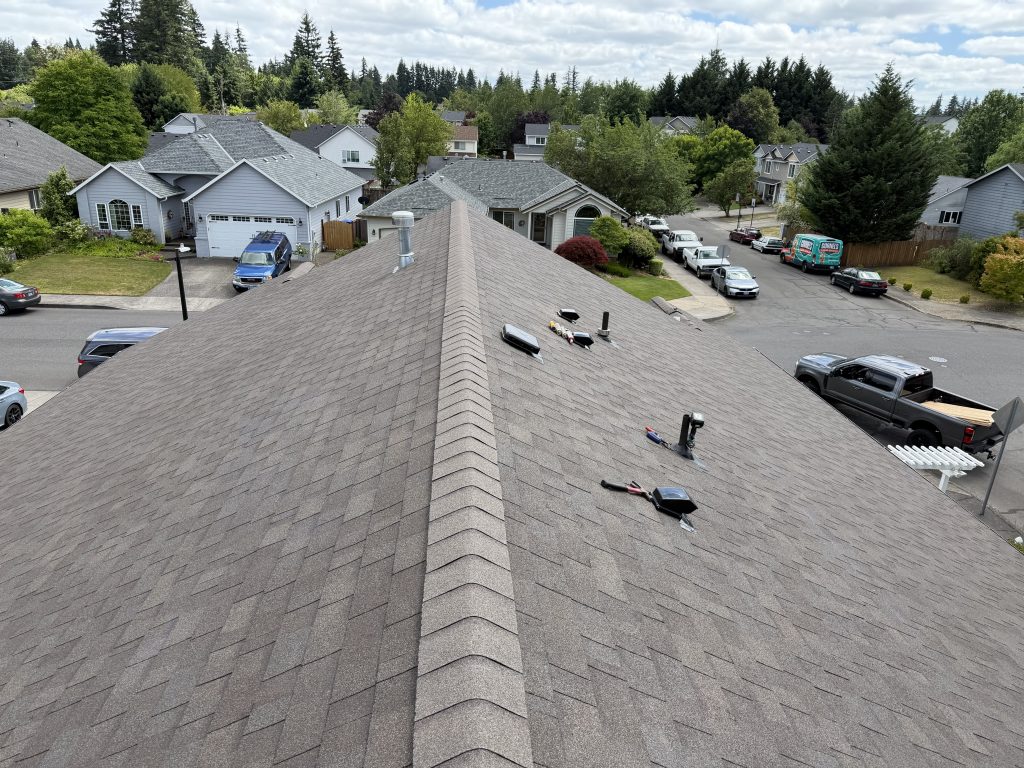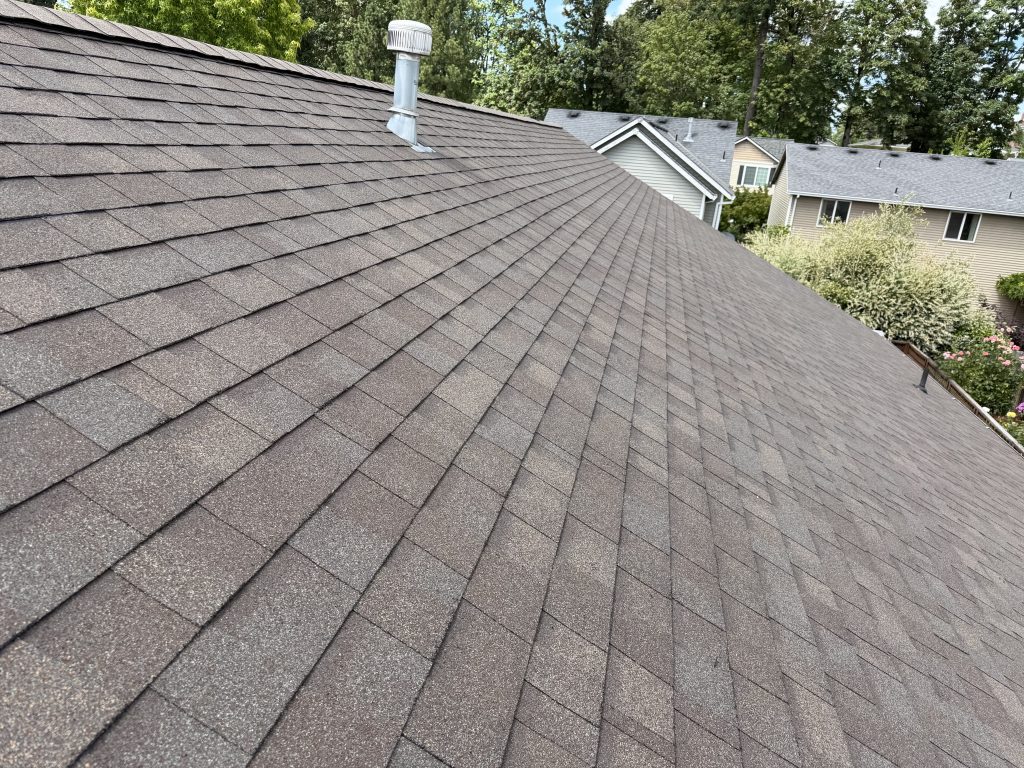
After every big wind event in Gresham and Troutdale, trucks with out-of-state plates show up offering roof inspections door to door. Some are fine. Some are not. The Oregon Construction Contractors Board’s own slogan is “Anyone can pretend to be a contractor. Check licenses.” This is how to check any roofing contractor in Gresham, Sandy or Boring, Oregon, plus the other questions worth asking before you sign anything.
Step 1: Look up the CCB license
Every contractor working in Oregon must be licensed with the CCB, and state rules require that license number to appear on their advertising, including their website. Take the number from the bid or the website and enter it at the CCB license search: search.ccb.state.or.us. You are looking for four things: the license is active, the business name matches the name on the bid, the license covers residential work, and there are no unresolved complaints or disciplinary actions.
Ours is Oregon CCB 261305. If you are in Clark County or elsewhere in Washington, our Washington license is BESTRRU743JP, which you can check through Washington L&I.
Step 2: Ask for proof of insurance
A CCB license requires a bond and liability insurance, but ask for the certificate anyway and check the dates. Roofing is high-risk work. If someone is hurt on your property and the contractor is uninsured, the claim can land on your homeowners policy.
Step 3: Ask about manufacturer certification
Shingle manufacturers certify contractors who install their products to spec, and those certifications are searchable. We are a Malarkey Certified Pro Contractor (#5838), which you can verify on Malarkey’s find-a-contractor page. Certification matters for one practical reason: enhanced manufacturer warranties usually require a certified installer, and the contractor has to register the warranty for you. We do that on every job.
Step 4: Read the bid like a contract, because it is one
A bid that just says “tear off and replace roof, $X” is not a bid. It is a placeholder for an argument later. A complete bid names the exact shingle product and color, the underlayment, the flashing work, how decking replacement is priced per sheet, who pulls the permit, what the cleanup includes, and what the workmanship warranty covers. Our roof cost guide has a full checklist.
Step 5: Talk to a real person at the company
Ask who will actually be on your roof. At Best Roofing USA, Ian Koons runs the crew himself and does the in-home consultations. His background is in roofing manufacturing, distribution and construction. Angela Koons handles operations and customer relations. You will talk to the people whose name is on the license.
Red flags
- No CCB number on the truck, website or bid
- Pressure to sign the same day, or a “today only” price
- A request for a large deposit before any material is ordered
- An offer to “handle” or negotiate your insurance claim for you (in Oregon, only licensed public adjusters may do that)
- A bid with no product names
- No local address
What the CCB license actually guarantees
A bond and insurance
To hold an Oregon CCB license a contractor must carry a surety bond and general liability insurance at levels the state sets. The bond is money that can be claimed against if the contractor fails to perform or pay. The insurance covers damage to your property. Neither is huge relative to the cost of a roof, but both are the floor, and an unlicensed contractor has neither.
A dispute process
If something goes wrong with a licensed contractor, you can file a complaint with the CCB, which offers dispute resolution and can act against the license. If something goes wrong with an unlicensed one, your options are small claims court and hope. The CCB’s own consumer pages are blunt about this, and their line “Anyone can pretend to be a contractor” is there because people do.
A public record
The license search shows the business name, the license status and dates, the type of work the license covers, and any complaints or disciplinary history. Two minutes with that page tells you more than an hour of sales conversation.
Reading the license search result
When you look up a number at the CCB search site, check four things and do not stop at the first one. Status must be active. Expired, suspended and inactive all mean stop. The business name on the license must match the name on your bid and the name on the truck; a mismatch sometimes means a different company is borrowing a number. The endorsement should cover residential work. And the complaint history should be empty or explainable. One resolved complaint in a decade is normal business. A pattern is a pattern.
Do the same on the Washington side if you live in Clark County. Washington L&I has its own contractor lookup, and a company doing work on both sides of the river needs both licenses. Ours are Oregon CCB 261305 and Washington BESTRRU743JP.
The storm chaser pattern, and how to spot it
After a big east wind event in Gresham or Troutdale, out-of-area roofing crews follow the weather reports. Some are legitimate companies expanding their reach. Some are not. The pattern to watch for is a knock on the door offering a free inspection, followed by a report of damage you cannot see from the ground, followed by pressure to sign a contract and an assignment-of-benefits form so they can “deal with the insurance for you.” A few weeks later the company is in another state.
Legitimate contractors do free inspections too. The difference is what happens next. A legitimate contractor gives you photos of the damage, a written bid, and time to get other bids. They do not ask you to sign anything on the porch. And in Oregon, a roofing contractor is not permitted to negotiate or adjust your insurance claim; only a licensed public adjuster or you can do that. Anyone who offers to handle the claim is either unaware of the rule or ignoring it.
Questions worth asking on the phone
- What is your CCB number? (If they hesitate, that is your answer.)
- Where is your office? A local address means they will be here next winter if something needs attention.
- Who will be on my roof: your crew or a subcontractor?
- Which shingle lines do you install, and are you certified by the manufacturer?
- Do you pull the permit and handle the inspection?
- What does your workmanship warranty cover, and for how long?
- Can I see photos of a recent job in my area?
For the record, our answers: CCB 261305. 27800 SE Sylvian Way in Boring. Ian Koons runs the crew himself. Malarkey, all three tiers, and we are a Malarkey Certified Pro Contractor. Yes on permits and inspections. Our workmanship warranty covers the installation; ask us for the written terms when you get your bid. And yes, we can show you our work.
Why manufacturer certification is worth more than it sounds
Certification programs exist because manufacturers get tired of paying warranty claims on roofs that failed because of installation rather than the product. So they train contractors, check their work, and in return extend better warranties on roofs those contractors install. For you that means two things. The install follows a written specification rather than the crew’s habits. And the enhanced warranty, which usually requires a certified installer and registration by the contractor, is actually available to you. We register the manufacturer warranty on every job so you do not have to think about it.
Reading a bid: a worked example
Imagine two bids for the same house in Happy Valley. Bid A is one page: “Tear off existing roof, install new architectural shingles, clean up. Total $X.” Bid B is three pages: shingle product and color by name, synthetic underlayment, ice and water barrier in valleys and at eaves, new step flashing at all walls, new pipe boots, ridge ventilation, decking replacement at a stated price per sheet, permit and inspection included, magnetic nail sweep, workmanship warranty terms, manufacturer warranty registration, total $Y.
If $X is lower than $Y, you have learned nothing yet, because you do not know what $X includes. Ask Bid A’s contractor for the same line items. If they cannot produce them, the bids are for different jobs and the lower number tells you nothing. Our roof cost guide has the full checklist to hold both bids against.
Keep the paperwork
Once the roof is done, keep the contract, the final invoice, the permit sign-off, the manufacturer warranty registration confirmation, and the photo report from the job in one folder. When you sell the house, that folder answers every question a buyer’s inspector will ask. When something needs attention in year eight, it tells the next contractor exactly what is up there. And if you ever need the warranty, it is the evidence the manufacturer will want to see.
Ready to see how we compare? Start with the instant estimate, then ask us every question on the list above.
Deposits, payment schedules and lien releases
A reasonable payment structure ties money to milestones: a deposit when material is ordered, a progress payment if the job spans more than a few days, and the balance when the work is complete and you have walked the roof with the contractor. Be wary of large up-front deposits before anything has been ordered, and of any pressure to pay in full before the cleanup is done. Ask how the contractor pays their suppliers, and ask for a lien release at the end, which confirms the material supplier has been paid and cannot place a claim on your home. Licensed contractors in Oregon are used to this request.
Written contract basics
The bid becomes the contract, so the contract should contain everything the bid does: scope, products, price, payment terms, start window, permit responsibility, cleanup, and warranty terms in writing. Oregon requires licensed contractors to provide certain consumer notices with residential contracts; the CCB publishes them, and their absence from a contract is a tell. Read the change-order clause too. It should say that any change in scope or price is agreed in writing before the extra work happens, which is exactly how the decking-replacement question should be handled.
Local means local
Best Roofing USA is a family-run company based at 27800 SE Sylvian Way in Boring. Ian and Angela Koons live here, and the crew works Boring, Sandy, Gresham, Damascus, Happy Valley, Estacada, Clackamas, the surrounding Portland metro, and Clark County across the river. That matters in a practical way: when a pipe boot needs resealing in year six, the company that installed the roof is twenty minutes away, with the same license number on the truck.
References you can check yourself
Ask for two or three recent customers in your area and actually call them. Ask whether the crew showed up when promised, whether the yard was clean afterward, whether the final invoice matched the bid, and whether anyone came back when asked. Our testimonials page has reviews from local homeowners, and you can find us on Google. Reviews are useful, but a five-minute phone call with a neighbor who used the company last summer is better than any of them.
Frequently asked questions
Is Best Roofing USA licensed in Oregon?
Yes. Oregon CCB 261305 and Washington BESTRRU743JP. Fully insured. Malarkey Certified Pro Contractor #5838.
What if a contractor’s license is expired?
Do not hire them until it is active again. An expired license means the bond and insurance requirements may not be in force, and you lose the CCB’s dispute resolution protection.
Should I get more than one bid?
Yes, and compare them line by line instead of by the bottom number. Two bids with different shingle products and different decking terms are not the same job.
Where can I read reviews?
Our testimonials page has reviews from local homeowners, and you can find us on Google.
Ready to compare a real bid? Get a 60-second instant estimate or call 971-251-ROOF. Best Roofing USA LLC, 27800 SE Sylvian Way, Boring, OR 97009. Oregon CCB 261305.