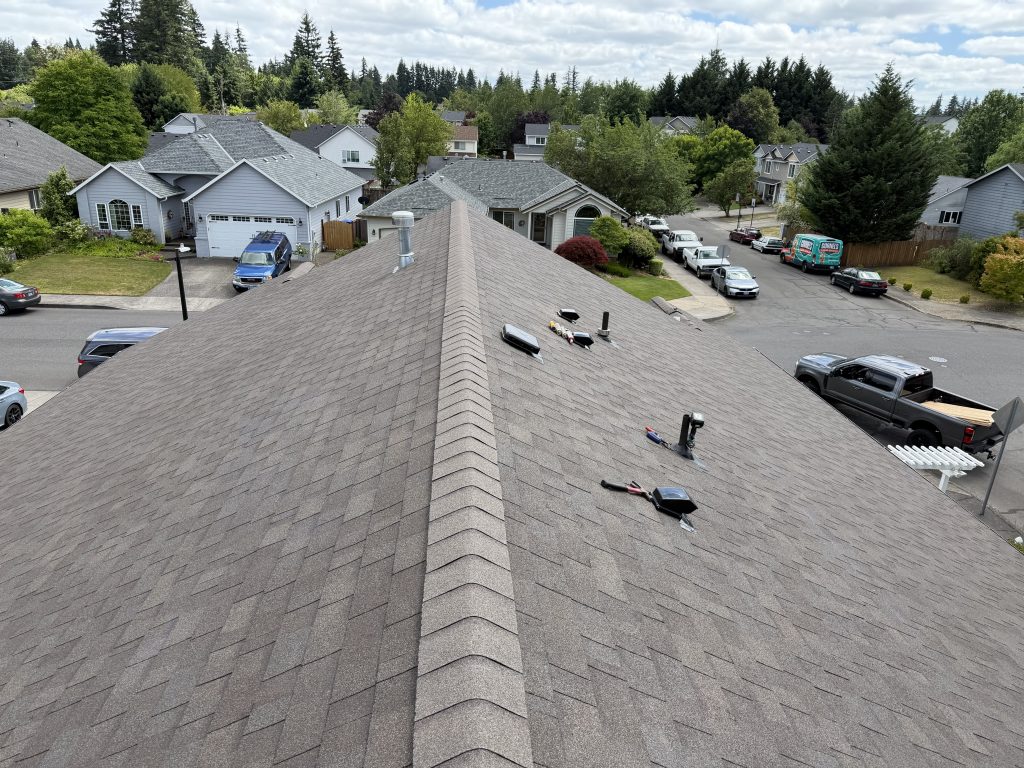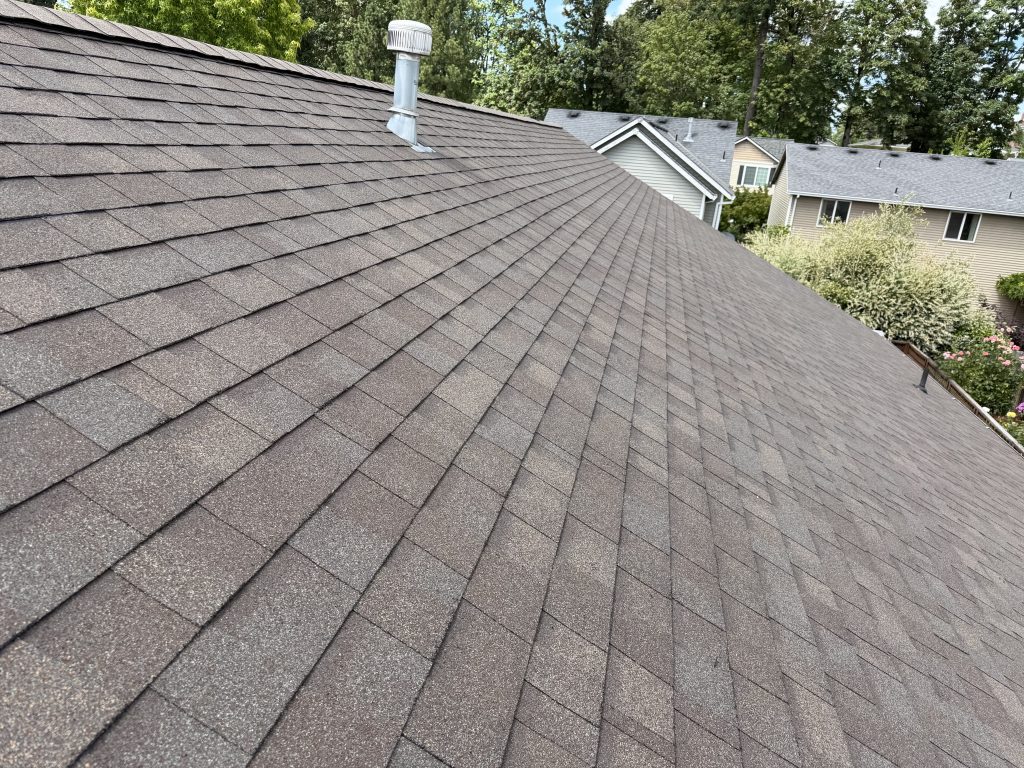
If you live in Gresham, Troutdale, Corbett or Wood Village you already know the sound. A high pressure system settles east of the Cascades, a low sits off the coast, and the Columbia River Gorge turns into a funnel that aims cold, dry wind straight at the east side of the metro. The National Weather Service issues wind advisories for the western end of the Gorge “from Washougal and Troutdale eastward” several times a winter, and gusts above 60 mph at Corbett are not unusual. Roofs in this corridor take more wind than roofs anywhere else in the Portland area, and it shows in the emergency roof repair calls we get every January.
How east wind damages a roof
Wind does not push shingles off. It lifts them. Air moving over a roof creates suction on the leeward slope and at the edges, and any shingle whose adhesive strip has failed or whose nails were placed too high starts to flutter. Once a tab lifts, the wind gets under the next one. That is why wind damage usually shows up as a patch of missing or creased shingles on one slope rather than a few scattered ones.
The other common failure is at the edges and ridge. Ridge caps, rake edges and the first course above the eave take the highest uplift. Roofs with no drip edge, or with starter strip installed wrong, lose shingles here first. Aging shingles are also the most vulnerable, because the sealant strip that bonds each course to the one below loses grip over time.
What to check from the ground after a wind event
- Shingle pieces or granule piles in the yard, driveway or gutters
- Tabs that look lifted, creased or folded back, especially on the slope facing away from the wind
- Missing or displaced ridge caps along the peak
- Flashing bent up at the chimney, at skylights or where the roof meets a wall
- Vents, pipe boots or satellite mounts that have shifted
- Tree limbs on the roof, or gouges where a limb hit and slid off
- Inside the house, new stains on ceilings or in the attic within a day or two of the storm
Please do not climb up to look. A wet or windy roof is one of the most common ways homeowners get hurt. Binoculars from the street and a flashlight in the attic will tell you most of what you need to know.
If you have an active leak
We offer same-day emergency service for active leaks. Move belongings out from under the drip, put a bucket down, and if water is pooling in a ceiling, poke a small hole to let it drain so the drywall does not collapse. Then call 971-251-ROOF. We will stop the leak and document the damage with photos.
Repair or replace?
A few lifted or missing shingles on an otherwise sound roof is a repair. A whole slope with creased tabs, or damage on a roof that was already near the end of its life, is often a replacement. A storm damage inspection with a digital photo report gives you the evidence to decide, and it is the same documentation an insurance adjuster will ask for. If your roof is due, we install Malarkey shingles at three tiers and register the manufacturer warranty on your behalf.
Building a roof for the Gorge
If you are replacing a roof anywhere east of 181st, ask your contractor about nailing pattern, starter strip, and edge detailing. Correct nail placement in the manufacturer’s nail zone is the single biggest difference between a roof that holds and one that does not. This is the kind of thing the Malarkey Certified Pro program trains for, and it is why we hold that certification.
Why the east wind is different from a normal storm
Most of the Pacific Northwest gets its wind from the southwest, arriving with rain in front of a Pacific low. The east wind is the opposite animal. It shows up on clear, cold days, it is dry, and it can blow for two or three days straight at a steady pace with gusts on top. Roofs are engineered to shed wind from any direction, but a sustained wind from one direction for 48 hours works on the same edge, the same ridge cap and the same lifted tab the whole time. Fatigue does the damage more than any single gust.
The geography is simple. The Cascades block cold, dense air on the east side of the range. When high pressure builds over eastern Oregon and Washington and low pressure sits off the coast, that air has one low-elevation path west: the Columbia River Gorge. It accelerates through the narrows and exits at Troutdale and Corbett, then spreads across Gresham, Wood Village, Fairview and the east edge of Portland. Homes closer to the Gorge mouth get the most of it. By the time the wind reaches Boring and Sandy it has lost some strength, but those areas still see gusts that lift shingles on aging roofs.
The three places roofs fail first
The rake edge
The rake is the sloped edge of the roof at the gable end. Wind hitting the gable wall is forced up and over that edge, creating lift right where the shingles end. A roof without a proper drip edge, or with shingles that overhang too far, loses its first tabs here.
The ridge
Ridge caps sit at the highest point and are exposed to wind from both sides. On an older roof the caps are often the first shingles to crack, because they are bent over the peak and the bend is where the asphalt ages fastest. When the sealant under a cap fails, the wind gets under it and peels it back. Then the next cap goes.
The leeward slope
Counterintuitively, the slope facing away from the wind often shows more damage than the one facing into it. Air flowing over the ridge separates from the roof surface and creates suction on the far side. Tabs on the leeward slope get pulled up rather than pushed down. If you are checking your roof after an east wind event, look at the west-facing slope first.
Why older roofs lose and new roofs hold
Every asphalt shingle has a strip of thermally activated sealant along its underside. When the roof is new and the sun warms it, that strip bonds the shingle to the course below, and the roof becomes one connected surface. Over the years that bond weakens. Granules wash into it, the asphalt gets brittle, and eventually a tab that used to be glued down is just resting there, held by nails alone. That is the roof the east wind takes apart.
A new roof installed to the manufacturer’s specification, with nails in the nail zone and the sealant strip allowed to bond in warm weather, is a different structure entirely. This is one of the reasons we talk about install timing; see our guide to the best time of year to replace a roof.
What the repair actually involves
For a handful of lifted or missing tabs, the repair is a matter of removing the damaged shingles, checking the underlayment beneath, replacing any torn underlayment, and installing new shingles that match as closely as the product line allows. On a roof more than a few years old, an exact color match is not always possible; shingles weather, and the manufacturer may have changed the blend. We tell you that up front rather than after.
For ridge cap damage, the caps are replaced along the affected run. For flashing that has been bent up, the flashing is reset or replaced and resealed. In all cases the crew checks the surrounding shingles for sealant failure, because the tab that blew off was rarely the only one that was loose.
Documenting damage for your own records
Whether or not you file an insurance claim, document the damage. Photograph the yard debris before you clean it up. Photograph the roof from the ground with the date visible on your phone. Note the date of the wind event; the National Weather Service issues advisories for the western Gorge and those are a matter of public record. When we come out, our storm damage inspection produces a digital photo report that shows every affected area from on the roof. That report is yours, and it is the kind of documentation an insurer expects to see.
On the insurance question itself, Oregon draws a clear line. A contractor can inspect, photograph and estimate. Negotiating or adjusting the claim on your behalf is the job of a licensed public adjuster or your own conversation with the insurer. We stay on the right side of that line, and we would be cautious of any roofer who offers to “handle the claim” for you.
Preparing a roof for next winter
- Get an inspection in late summer, while the roof is dry and repairs are easy to schedule.
- Have loose ridge caps and lifted tabs resealed or replaced before the first advisory.
- Trim limbs that overhang the roof; the east wind turns them into hammers.
- Check that vents, satellite mounts and solar attachments are secure.
- If the roof is near the end of its life, plan the replacement for the dry season so the new shingles seal before the wind arrives.
Our maintenance plans put that inspection on the calendar every year so it does not depend on remembering. And if the roof is due, the instant estimate gives you a number in under a minute.
Trees, limbs and the east wind
Shingle damage gets the attention, but the most expensive east-wind roof calls we see involve trees. Douglas fir limbs are heavy, and a sustained wind snaps them at the trunk and drops them onto whatever is below. A limb that lands on a roof does not usually punch through, but it slides, and the slide strips shingles and tears underlayment along its path. Larger limbs bend gutters and crack fascia on the way down.
The prevention is unglamorous: have an arborist look at anything overhanging the roof before winter, and remove dead limbs on the east and northeast sides of the house where the wind loads them. The same trimming reduces moss on the roof below, which is the rare case where one job solves two problems.
Vents, boots and the small stuff
Most winter leaks we trace after a wind event turn out to start at a penetration rather than a shingle. A plastic pipe boot cracks after a decade of sun, the wind flexes it, and water finds the gap. A turbine or box vent loses its cap. A satellite dish mount that was lagged into the shingles instead of the rafter works loose. These are inexpensive to fix in September and expensive to discover in December. When we inspect after a wind event we photograph every penetration, because that is where the next leak is hiding.
What to tell us when you call
If you have an active leak, say so first; that moves you into the same-day queue. Then tell us where the water is showing inside, whether you can see missing shingles from the ground and on which side, whether a limb is on the roof, and when the wind event was. Photos from your phone help. If it is a non-urgent inspection, tell us the roof’s approximate age and whether it has been inspected before. We will schedule the storm damage inspection and bring the photo report to your door.
Frequently asked questions
How fast can you come out after a storm?
Same-day emergency service for active leaks. Non-urgent storm inspections are scheduled as soon as we can get to you.
Does homeowners insurance cover wind damage?
Most policies cover sudden wind damage. Coverage depends on your policy and your insurer’s decision. We provide photographs and a repair estimate you can submit; we do not negotiate or adjust claims.
Can a few missing shingles wait until spring?
Every missing shingle exposes the underlayment, and the next wind takes the shingles around it. Small repairs done quickly stay small.
Do you serve Corbett and the Gorge?
Yes. We serve Gresham, Troutdale, Fairview, Wood Village, Corbett and the surrounding Portland metro from our base in Boring.
Leaking right now? Call 971-251-ROOF. Thinking about replacement? Get a 60-second instant estimate. Best Roofing USA LLC, Boring, Oregon. Oregon CCB 261305.