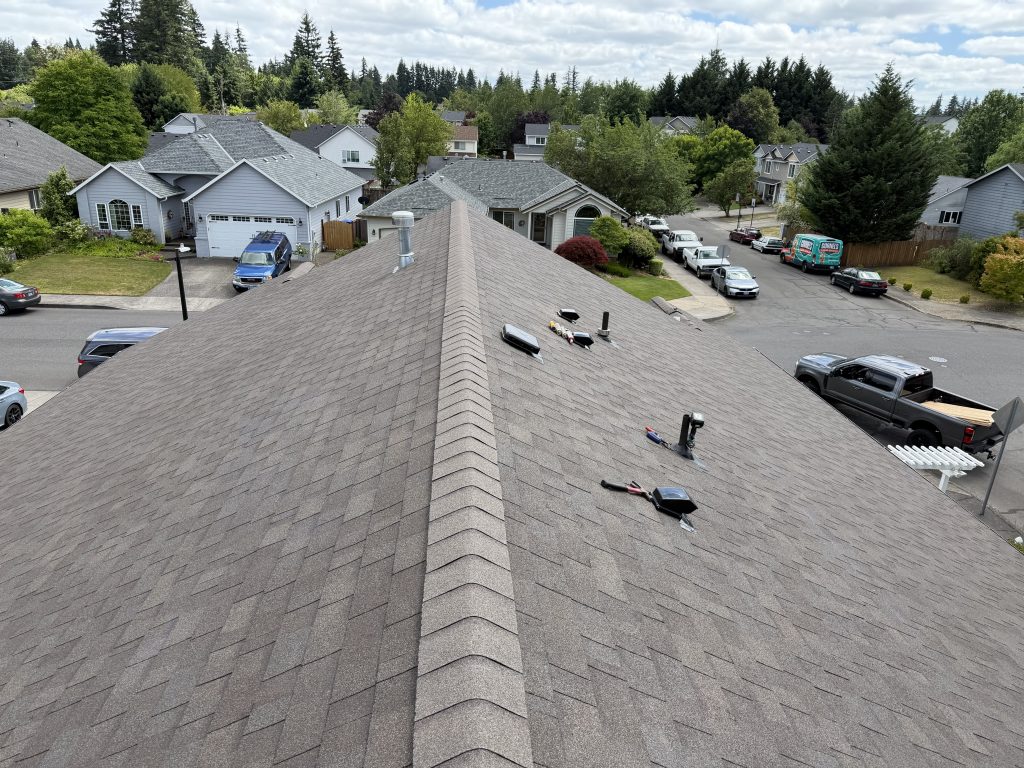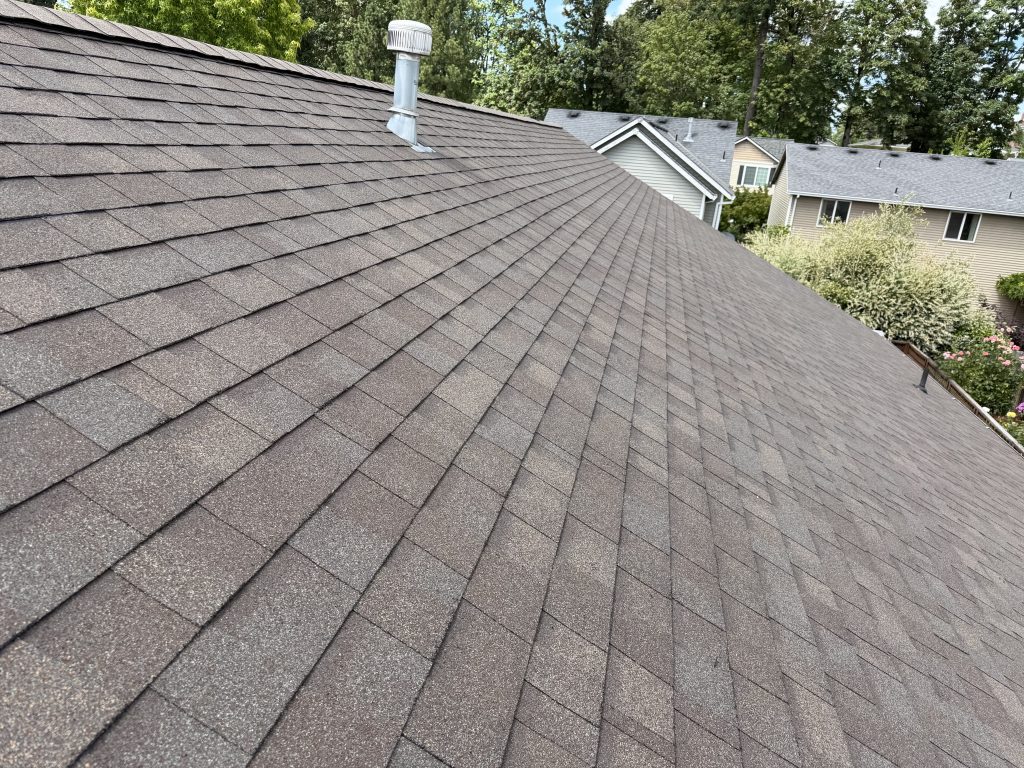
Drive any street in Boring, Sandy or Damascus in February and you will see it: a green stripe along the north slope of half the roofs. Roof moss is part of living at the foot of the Cascades, and roof moss removal is one of the questions we hear most. It is also the most common reason we see shingles fail years before they should. This guide covers why it grows here, what it does to a roof, and how to deal with it without making things worse.
Why moss loves roofs east of Portland
Sandy averages roughly 60 inches of rain a year, with a wet season that runs from mid October into May. Add tall firs and cedars shading the roof, and a north-facing slope that rarely dries out, and you have the ideal moss habitat. Boring and Damascus sit in the same band. Gresham and Happy Valley sit a little lower and drier, but shaded slopes there grow moss just as well.
What moss actually does to shingles
Oregon State University Extension puts it plainly: moss itself does not eat roofing. The damage comes from what it holds. A moss mat traps soil and debris and keeps the surface wet long after the rain stops. On asphalt shingles that constant moisture lifts the shingle edges, lets water get under the overlap, and strips the protective granules. On the wood decking below, prolonged wetness invites fungal decay. Left alone for a few winters, a mossy roof turns into a roof with soft decking, and that is the difference between a cleaning and a replacement.
Removal: what works and what to avoid
Avoid pressure washing
A pressure washer strips granules off asphalt shingles and can drive water up under the laps. OSU Extension warns that pressure washing takes experience to do without damage. We do not recommend it on composition roofs.
Brush and treat
The standard approach is to remove the bulk of the moss with a soft brush or long-handled tool, working down the slope so you do not lift shingles, then apply a treatment to kill what is left. OSU lists zinc sulfate and potassium salts of fatty acids (a soap-based, biodegradable option) as common choices. Zinc corrodes copper, so do not use it if you have copper gutters or flashing. Whatever the product, follow the label. Our treatments are chosen to be safe for landscaping, pets and people.
Change the environment
The long-term fix is sunlight. Trimming branches that shade the roof does more to keep moss away than any single treatment. As one OSU expert put it, you can clean all you want, but if you do not let the sun in the moss comes back.
Timing
Treat in the dry months so the product has time to work before the rain returns. A late-summer or early-fall treatment, with gutters cleared once the leaves are down, is the rhythm that keeps most roofs here clear. Roof work is also safer when the surface is dry.
When a maintenance plan makes sense
If your roof is under heavy tree cover, a single cleaning buys you a season. A schedule buys you the rest of the roof’s life. Our maintenance plans (Bronze $29.99, Silver $49.99 and Gold $59.99 a month) put inspections and treatments on a schedule so the work happens on a calendar instead of when you notice a problem. See what each plan includes on our services page.
How to tell moss from algae and lichen
Not every green or black mark on a roof is moss, and the treatment differs. Moss is the thick, spongy growth you can pick up in a clump. It has roots-like structures that hold soil and it stands up off the shingle. Algae is the dark streaking that runs down the slope in vertical bands, usually on the side that gets the least sun. It is mostly cosmetic and it does not hold water the way moss does. Lichen is the flat, crusty, grey-green patch that seems glued to the shingle, and it is the hardest to remove because it bonds to the granules.
Moss is the one that shortens a roof’s life, because of the moisture it traps. Algae is the one homeowners worry about most because it is ugly from the street. Lichen is the one that comes off with granules attached if you scrub it. Knowing which you have tells you how urgent the problem is and how gently it needs to be handled.
Why the north slope is always worse
Walk around any house in Boring and the moss is on the north and northeast slopes. Those faces get the least direct sun, so they dry last after every rain. In a climate with a seven-month wet season, “dries last” can mean “never fully dries” from November through April. Add a Douglas fir dropping needles onto that slope and you have a slow-release supply of organic matter for the moss to root into. That is why the same roof can look brand new from the driveway and ten years older from the backyard.
It is also why the OSU Extension advice about sunlight is the advice that actually works. Every treatment is temporary. Cutting back the branches that shade the north slope is the only change that shifts the odds permanently.
What a moss treatment visit looks like
People sometimes expect a power washer and a couple of hours of noise. A proper treatment on asphalt shingles is quieter than that. The crew inspects the roof first and photographs any areas where the moss has already lifted shingles or where the deck feels soft underfoot. The bulk of the moss is removed with soft tools, working down the slope so nothing is pushed up under the shingle laps. Gutters and valleys are cleared because that is where the removed material collects. A treatment is then applied to kill what remains, and the dead moss weathers off over the following weeks of rain.
Our treatments are chosen to be safe for landscaping, pets and people. That is a product choice, and it is worth asking any contractor what they spray and whether it will hurt the rhododendrons under the eave.
Why we say no to pressure washing
An asphalt shingle is a fiberglass mat coated in asphalt and covered in mineral granules. The granules are what protect the asphalt from the sun. A pressure washer removes moss by removing the surface the moss is attached to, which means it removes granules. Do that once and the roof looks clean and has lost years of life. Do it twice and the asphalt underneath starts to show. The OSU Extension guidance is careful on this point: pressure washing can work for someone experienced, but the margin for error is small, and on a composition roof the damage is permanent.
Pressure washing also drives water up under the laps, which is the direction water is never supposed to travel on a roof. On a roof with aging sealant strips, that alone can start a leak.
The maintenance plan math
Think of moss as a compounding problem. Year one it is cosmetic. Year three it is holding water against the shingle. Year five the decking under it is soft. Year seven the roof that should have lasted another decade is being replaced. A maintenance plan interrupts that curve at year one, every year.
Our plans are Bronze at $29.99, Silver at $49.99 and Gold at $59.99 a month, billed monthly. Each puts inspections and treatments on a calendar so the work happens before a problem, and each inspection comes with a digital photo report so you can see the roof’s condition year over year. The full breakdown of what each plan includes is on our services page. For a roof under heavy tree cover in Sandy or Damascus, the monthly figure is small next to the decking replacement it prevents.
When moss has already won
Sometimes the inspection tells a harder story: the moss has been there long enough that shingles are lifted along a whole slope, granules are gone, and the deck flexes underfoot. Cleaning that roof would be spending money to make a failing roof look better. At that point we say so, and the conversation shifts to replacement. We recommend a full tear-off on every replacement so the damaged decking gets found and fixed rather than covered. Our guide to roof lifespan lists the signs that a roof has crossed that line.
Do it yourself safely, if you must
If you are set on handling a small roof yourself, the OSU Extension safety list is the one to follow. High-traction footwear. A ladder on stable ground extending at least three feet above the roofline. A safety line on anything steep. Never carry tools up the ladder; haul them up in a bucket. Work in dry weather. And read the label on whatever product you use, because zinc sulfate in particular corrodes copper and can stain surfaces it drips onto. Most falls happen on wet, mossy roofs in exactly the conditions that make people want to clean them. If any of that list gives you pause, call us instead.
Whether you need a cleaning, a plan, or a straight answer about replacement, the instant estimate is the fastest way to get the conversation started.
Moss and your homeowners insurance
Insurance covers sudden damage, such as a tree limb through the roof in an east wind. It generally does not cover wear, neglect, or gradual deterioration, and moss damage is the textbook example of gradual deterioration. A roof that fails because moss rotted the decking over eight years is a maintenance problem in the insurer’s eyes. Some insurers in the Portland area will also note visible moss at renewal and ask for it to be addressed. Keeping the roof clean is one of the few things that protects both the roof and the policy.
Selling a house with a mossy roof
Buyers’ inspectors in Boring, Sandy and Happy Valley have seen a lot of mossy roofs, and they know what is usually underneath. A green north slope on the listing photos invites a roof credit request during negotiation, often for far more than a cleaning would have cost. If you are listing in the next year, a treatment in late summer and a real estate inspection with a photo report gives you something to hand the buyer instead of something to argue about. We do real estate inspections for exactly this situation.
Metal and other roof types
Moss grows on metal roofs too, usually in the seams and at the eave where debris collects, and OSU Extension notes it can lift metal panels and let water under them. Cedar shake roofs, still common on older homes around Estacada and Sandy, are the most vulnerable of all, because the moss roots directly into the wood. The treatment approach is the same in principle: remove gently, treat, let the sun in. The tools and products differ, and it is worth telling us what you have before we come out.
Frequently asked questions
Does moss mean I need a new roof?
Not by itself. Moss on a roof with sound shingles and a solid deck is a cleaning job. Moss on a roof that already has curling, bare patches or soft spots is a sign the roof is near the end. An inspection with a photo report tells you which one you have.
Can I use bleach on roof moss?
Bleach kills moss but runs off into landscaping and can discolor shingles and corrode metal. There are gentler products made for the job.
Do zinc strips work?
Zinc strips at the ridge release small amounts of zinc as rain runs over them and can slow regrowth on the area below. They work best alongside cleaning and tree trimming.
Will you inspect the roof before quoting a moss treatment?
Yes. Every inspection includes a digital photo report so you can see the condition of the shingles and flashing yourself.
Not sure whether your roof needs a cleaning or a replacement? Get a 60-second instant estimate or call 971-251-ROOF. Best Roofing USA LLC, Boring, Oregon. Oregon CCB 261305.